AEG Appliance Repair Toronto: European Engineering & Precision Service
AEG brings 130+ years of German engineering precision to kitchen and laundry appliances — a heritage that shows up in both performance and the specifics of repair work. From ProClean dishwasher spray systems to SteamBake ovens and ÖKOMix washing machines, AEG appliances are built around distinct technical approaches that generic appliance service often misses. At JK Appliances Toronto, we service AEG appliances across the GTA with an understanding of what makes European engineering different and what that means for diagnosis, parts sourcing, and repair longevity.
Quick Answer: AEG appliances use European engineering standards and components that differ from North American mainstream brands. Common service needs include dishwasher spray arm failures, oven heating element issues specific to European voltage conversion, and control board problems. Parts must meet AEG specifications to maintain performance and warranty coverage. Professional diagnosis ensures repairs preserve the precision AEG owners expect.
What Makes AEG Different
European Engineering Standards
AEG is part of the Electrolux Group but maintains its own design language rooted in German precision engineering. This isn't marketing — when you open an AEG appliance you see metric fasteners throughout, control boards designed around European electrical standards then adapted for North American voltage, and component tolerances tighter than what mainstream North American brands specify.
For repair purposes: this means parts sourcing requires access to European supply chains and an understanding of which components can be substituted and which cannot. Generic "universal" parts sold as compatible with AEG often don't match original specifications closely enough to maintain AEG performance levels.
ProClean Dishwasher Technology
AEG dishwashers use a satellite spray arm system — a secondary rotating arm mounted on the main lower spray arm that increases water coverage without requiring higher pump pressure. This delivers better cleaning with less water, but the bearing and seal assembly is a wear point that differs from conventional spray arm designs.
Common issue: The satellite arm bearing fails, causing the secondary arm to stop rotating. Dishes on one side of the lower rack don't clean properly. This requires an AEG-specific satellite arm assembly; aftermarket "fits AEG" spray arms typically lack the bearing quality of the original and fail again within months.
SteamBake Oven Systems
AEG ovens with SteamBake inject steam during the first phase of baking to improve crust development and moisture retention. The steam generator is a small reservoir with a heating element that creates steam pulses on demand. Unlike continuous-steam systems, SteamBake is intended for intermittent use, and the generator assembly requires specific descaling procedures.
Common issue: Hard water mineral buildup clogs the steam injection ports, causing steam errors or uneven steam distribution. The fix requires disassembly and citric acid flush of the generator, following AEG's procedure. Generic descaling or forcing steam operation with a clogged system damages the heating element.
ÖKOMix Washing Machine Technology
AEG front-load washers with ÖKOMix pre-mix detergent and softener before they enter the drum, activating them more effectively and reducing residue on clothes. The mixing chamber is a sealed assembly with inlet valves and a small internal pump. This system delivers measurably better detergent activation than conventional dispensers but introduces additional points of failure.
Common issue: The mixing chamber seals degrade, causing water to leak into the dispenser drawer or fail to properly mix detergent. This requires replacing the entire ÖKOMix assembly — it's not serviceable at the seal level — and the part must be genuine AEG because the valve timing and pump pressure are calibrated specifically for this system.
Common AEG Service Needs in Toronto
Dishwasher Spray System Issues
Beyond the satellite arm bearing discussed above, AEG dishwashers also experience:
- Upper spray arm detachment: The upper arm mounting uses a bayonet lock that can crack if dishes are forced in, causing the arm to fall during cycles
- Pump filter housing cracks: The self-cleaning filter housing is made from a specific polymer that degrades with prolonged exposure to high-TDS water (common in Toronto's supply), leading to hairline cracks and slow leaks
- ComfortLift mechanism binding: Models with the powered lower rack that lifts to counter height develop binding in the lift mechanism's guide rails — requires lubrication and sometimes rail replacement
Oven Control and Heating Issues
AEG ovens have specific failure modes:
- Heating element voltage mismatch: Some AEG ovens imported for Canadian market use heating elements designed for 230V operation, stepped down internally. When these elements fail, using a generic North American 240V element changes the heat distribution pattern
- Pyrolytic cleaning cycle errors: Self-cleaning AEG ovens lock the door and heat to 500°C. The door lock mechanism is more robust than mainstream brands but the high-temp relay that controls the pyrolytic cycle is a known wear point
- Temperature sensor drift: AEG ovens use PT1000 temperature sensors (1000Ω resistance at 0°C) rather than the more common PT100 sensors used in North American appliances. Generic sensor replacements read incorrectly and cause calibration errors
Washer and Dryer Control Boards
AEG laundry appliances with touchscreen controls experience:
- Capacitive touch failure: The control panel uses capacitive touch technology that can fail if moisture enters the panel seal — more sensitive than mechanical button designs
- European voltage regulator failure: Like the ovens, AEG laundry machines use control boards designed around European standards. The voltage regulator that steps down North American 120V to the board's operating voltage is a failure point
- ÖKOMix pump clogging: Detergent residue builds up in the mixing pump, causing the pump motor to overheat and trip. Requires disassembly and cleaning, not just pump replacement
Why AEG Repair Needs Specialized Knowledge
Parts Sourcing Requirements
AEG parts distribution in North America is concentrated through authorized service channels. This is by design — Electrolux Group maintains tighter control over AEG parts quality than over its other brands, reflecting AEG's positioning as the premium tier.
What this means for service: repair shops need established relationships with authorized AEG parts distributors. The aftermarket for AEG parts is thinner than for mainstream brands, and the generic parts that are available often don't meet original specifications. For components like control boards, heating elements, and pump assemblies, genuine parts are not optional — they're required to maintain AEG performance.
Diagnostic Procedures
AEG appliances use error code systems based on European standards. The codes themselves are similar to other brands, but the diagnostic trees differ because the underlying component architecture is different.
Example: An AEG dishwasher throwing an i30 error (water in base pan, anti-flood activated) requires checking not just the obvious door seal and hose connections, but also the spray arm bearing seals and the ÖKO pressure sensor — failure points specific to AEG that don't exist in mainstream dishwashers. Generic dishwasher diagnostic procedures miss these AEG-specific paths.
European vs North American Standards
This isn't about metric vs imperial (though that's part of it). European appliance standards prioritize different things:
- Water efficiency over cycle speed: AEG dishwashers run longer cycles than North American brands because they use less water and rely on longer soak times for cleaning. Owners sometimes think this is a malfunction
- Lower wash temperatures: AEG washers default to cooler wash temperatures (30-40°C typical) than North American machines, relying on longer mechanical action and better detergent activation. Again, not a malfunction, but owners familiar with North American machines sometimes request "fixes" for design behavior
- Higher spin speeds: AEG washer spin cycles reach 1400-1600 RPM (vs 1200 typical for North American brands), removing more water but creating more vibration if the machine isn't perfectly level. This requires more careful installation and balancing
AEG Service Approach at JK Appliances Toronto
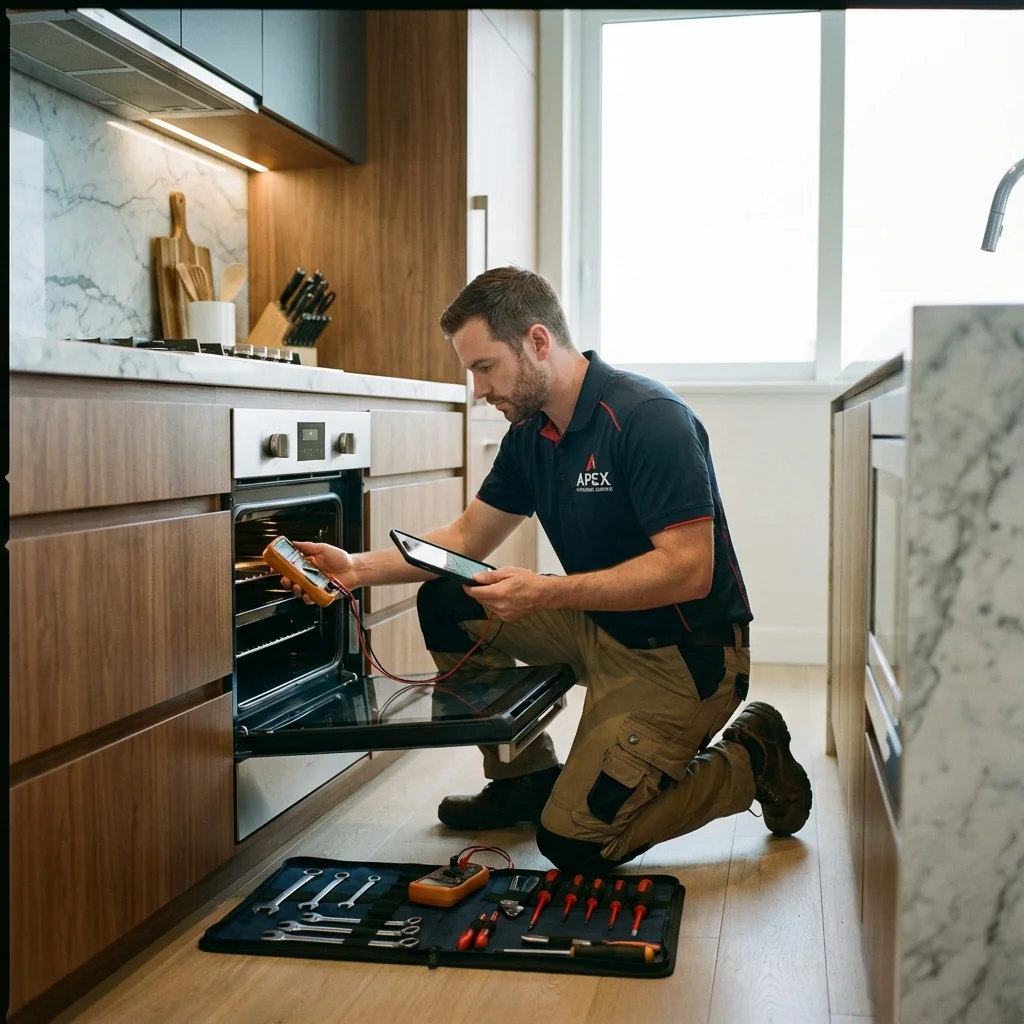
Initial Diagnosis
We start with the error code (if one is displayed) but treat it as a starting point, not a conclusion. AEG error codes point to a system, not necessarily a single component. For example, an E30 error (door lock fault) can mean:
- Failed door lock mechanism
- Failed door lock relay on control board
- Wiring fault between control board and lock
- Software fault where the lock is working but the board isn't reading its state correctly
We test each possibility rather than replacing the first component the code suggests.
Parts Verification
Before ordering parts, we verify:
- Model-specific compatibility: AEG uses rolling updates to component specs. A control board that fits a 2019 model may not work in a 2021 model even though the model number is the same
- Voltage and frequency specs: For electrical components, we verify the part is designed for North American voltage/frequency, not a European-spec part that happens to physically fit
- Genuine vs aftermarket: For wear items like pump seals or hose clamps, aftermarket can work. For control boards, heating elements, pumps, and motors, genuine AEG parts are required
Toronto-Specific Considerations
Water hardness: Toronto's water (supplied by Lake Ontario) averages 7-8 grains per gallon hardness. This is moderate by North American standards but higher than what AEG appliances encounter in soft-water regions of Europe. We see accelerated scale buildup in:
- Dishwasher spray arm bearing seals
- Steam oven generators
- Washer inlet valve screens
Regular descaling maintenance is more important in Toronto than AEG's European service documentation suggests.
Voltage stability: Older Toronto neighborhoods (pre-1960s housing stock) sometimes have voltage sag issues during peak demand. AEG control boards, with their European-design voltage regulators, are more sensitive to under-voltage conditions than North American boards. We've traced intermittent control board failures to voltage sag that other appliances in the same house tolerate without issue.
Preventive Maintenance for AEG Appliances
Dishwashers
- Monthly: Run a cleaning cycle with dishwasher cleaner (citric acid based) to prevent scale buildup in the spray system
- Quarterly: Remove and clean the filter assembly, inspect the satellite spray arm bearing for play
- Annually: Professional descaling of the spray arm distribution manifold, inspection of door seal and hinge springs
Ovens
- After each pyrolytic clean: Check door lock mechanism operates smoothly, verify oven light still works (high heat can shorten bulb life)
- Every 6 months: Clean steam injection ports (SteamBake models), verify oven temperature with an independent thermometer
- Annually: Professional inspection of heating elements and door hinge balance
Washers
- Monthly: Run a drum cleaning cycle at 90°C with no load, clean the dispenser drawer and ÖKOMix chamber (if equipped)
- Quarterly: Inspect door seal for detergent residue buildup, check inlet hose screens for debris
- Annually: Professional inspection of the suspension system and door seal, lubrication of drum bearing
When to Repair vs Replace
AEG appliances are premium-tier purchases. A typical AEG dishwasher costs $1,200-2,000 new; an AEG front-load washer $1,500-2,500. Repair economics are different than for mainstream brands.
Repair makes sense when:
- The appliance is under 7 years old (AEG appliances are built for 10-15 year service life if maintained)
- The failure is a single component (pump, control board, heating element)
- The cabinet and major assemblies (drum, spray arms, door) are in good condition
Consider replacement when:
- Multiple major components have failed (control board + pump + heating element suggests the appliance reached end of design life)
- The cabinet or door shows rust (indicates water leak that has gone unaddressed long enough to cause structural damage)
- Parts are no longer available (AEG maintains parts inventory for 10 years after discontinuation, but older models may be orphaned)
Why Choose JK Appliances for AEG Service
- European brand experience: We service AEG alongside Miele, Bosch, and other European brands, so we understand the engineering differences that matter for diagnosis and repair
- Genuine parts access: Established relationships with authorized AEG parts distributors ensure we get correct parts on the first order
- Toronto-specific knowledge: We understand how Toronto's water, voltage, and housing stock affect AEG appliance performance and longevity
- 180-day parts and labor warranty: Every AEG repair is backed by our 180-day warranty — double the GTA market standard of 90 days
Service Coverage
We service AEG appliances throughout the Greater Toronto Area:
- Toronto, North York, Scarborough, Etobicoke
- Mississauga, Brampton, Oakville, Burlington
- Vaughan, Richmond Hill, Markham, Thornhill
- Pickering, Ajax, Whitby, Oshawa
Same-day and next-day service available for most postal codes. Emergency service for failed appliances under warranty or causing active water leaks.
Contact JK Appliances Toronto
Phone: (647) 560-8966
Hours: Monday-Saturday 8am-7pm, Sunday 9am-5pm
Service Area: Greater Toronto Area
Warranty: 180 days parts and labor on all repairs
For AEG appliance service that understands what makes European engineering different and what that means for diagnosis, parts, and repair longevity, contact JK Appliances Toronto. We bring the precision and attention to detail that matches what AEG builds into their appliances.